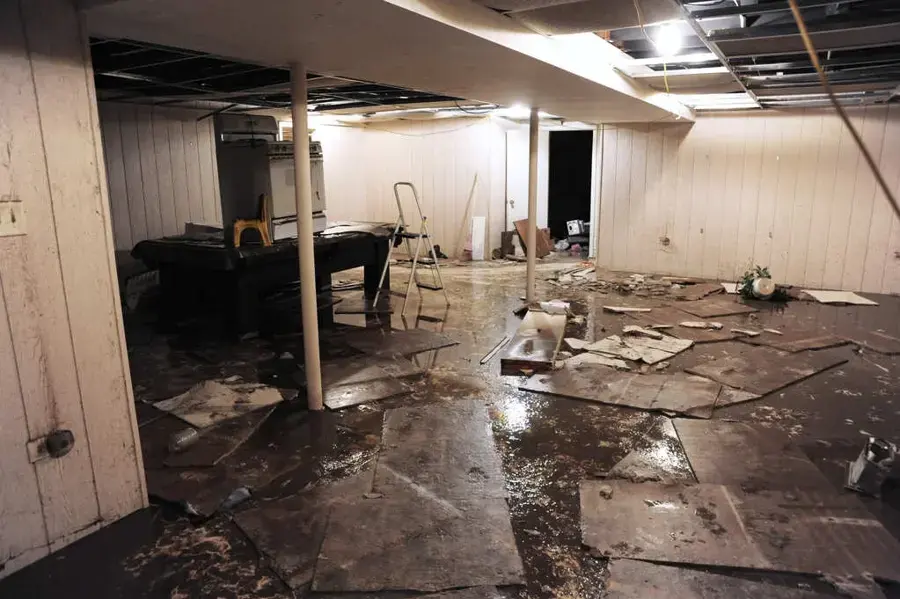
A basement that stays dry for months can start weeping at the base of a block wall after one long rain. The water is not coming from a pipe, and that changes how it is stopped and dried.
Key takeaways
- Seepage is pressure from wet soil outside the wall, not a plumbing failure, so shutting off the main does nothing.
- Georgia Piedmont red clay drains slowly, so rain sheets off yards and soaks the ground next to the foundation.
- Block walls are hollow, so water can travel inside the cores and show up far from where it entered.
- Standing water is extracted first, then walls, floor edges and anything stored on the floor are dried to a reading.
- A wet basement that sits more than a day or two raises the chance of mold, so speed matters.
Why a block basement wall leaks after rain
Much of Lilburn went up between the 1970s and the 1990s, around the older rail town core of Old Town Lilburn. Split level and basement ranch homes on sloped lots are common in that housing stock.
Many of those basements are built with concrete block. Block is strong, but it is porous and full of joints.
Hydrostatic pressure in plain words
When soil around a foundation fills with water, the water pushes on the wall from outside. Builders call that hydrostatic pressure.
The water finds the weakest path: a mortar joint, the seam where the wall meets the floor, or a crack that was too small to notice in dry weather.
Why red clay makes it worse
The Georgia Piedmont red clay under Lilburn yards drains slowly. Instead of soaking in, storm water sheds toward the house and sits against the foundation.
Heavy summer thunderstorms and tropical remnant rain in a humid subtropical climate can keep that clay saturated for days.
Seepage or a pipe leak: how to tell
The first question for any wet basement is whether the water is coming in or coming out. The pattern usually answers it.
A plumbing leak follows a pipe, a water heater or an appliance. Seepage follows the weather.
- Timing: seepage appears during or after rain and fades as the ground dries, while a pipe leak keeps going in dry weather.
- Location: seepage shows low on exterior walls and at the floor edge, while a pipe leak shows near fixtures, risers and the water heater.
- Water meter: if the meter keeps moving with every tap closed, the cause is a pipe, not the soil.
- Staining: white powder on block is mineral residue left as seepage water evaporates.
- Sump pit: a pit that is full or a pump that is running constantly points to a high water table, not a broken pipe.
What the first hour looks like
Safety comes before the water. Turn off power to any outlet or appliance that sits in or near the wet area, and stay out of standing water if a panel or cord is nearby.
Then move what can be moved. Boxes, rugs, furniture legs and stored papers wick water quickly.
- Lift cardboard and fabric onto plastic or onto a dry upper floor.
- Photograph the wall, the floor and the damage before anything is moved.
- Run a wet vacuum only if the water is shallow and the outlet is dry and protected.
- Skip bleach and fans pointed at a wet wall until the water is removed, since moving air alone cannot dry soaked block.
How the crew handles standing water and wet block
When water has pooled across the slab, the extraction crew pulls it with pumps and truck mounted or portable extractors. That step comes first because every hour of standing water pushes moisture further into the walls and floor edge.
After extraction, the drying team maps where the water went with moisture meters and a thermal camera. Hollow block is the reason this step matters, because water can run down inside the cores and sit at the bottom course.
Drying the wall, not just the floor
Air movers push dry air across the wall surface and low grade dehumidifiers pull moisture out of the room. The goal is a reading that matches an unaffected wall in the same basement.
A visible dry surface is not the goal. The readings are.
What gets removed
Block itself stays. What often goes is the wet material touching it: carpet and pad, baseboard, the bottom of finished drywall and insulation on a framed wall.
Removing only what readings call for keeps the cost down and the basement usable. The drying time estimator gives a rough sense of how long drying can take.
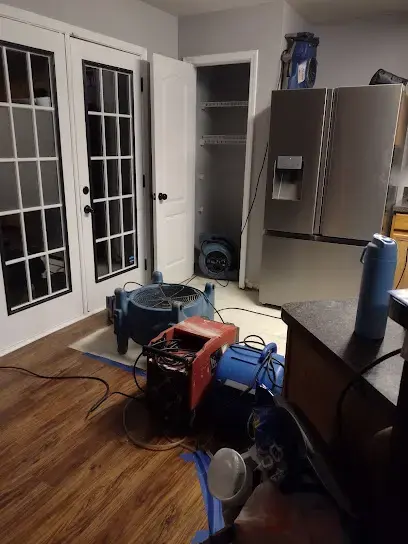
Checking a basement before the next storm
Most seepage is predictable. The same wall tends to leak in the same place storm after storm.
The seepage risk check walks through the usual warning signs, and a short walk around the house helps too.
- Gutters and downspouts: clear them and send the water away from the foundation.
- Grade: look for soil that slopes toward the house instead of away from it.
- Window wells: remove leaves and debris so they can drain.
- Sump pump: test it by pouring water into the pit and confirm the discharge pipe is clear.
- Cracks and joints: note hairline cracks and efflorescence on block so a pattern is easy to see next time.
When the sump pump is part of the problem
Some basements have a pit and pump that handle seepage quietly. When a storm knocks out power, that protection stops.
If the pump fails during steady rain, the water rises at the wall and floor edge fast. The page on sump pump failure cleanup covers what happens after a pump quits.
What to expect from a Lilburn basement flooding response
A basement flooding job moves in a set order: stop the source if there is one, extract, map moisture, remove only what cannot dry, then dry to a reading and document it.
That documentation helps with an insurance claim. Seepage coverage varies by policy, so the policy language and the adjuster decide what is paid.
For a basement already taking on water, basement flooding cleanup in Lilburn and water extraction describe the full process.
Questions
Is water through a basement block wall a plumbing problem?
Usually not. Water that appears during or after rain and fades as the ground dries is seepage from wet soil. A plumbing leak keeps flowing in dry weather and follows a pipe, a water heater or an appliance.
Why does the same Lilburn wall leak every storm?
Slow draining Piedmont red clay holds water against the foundation, and the weakest joint or crack in the block gives way each time. The leak repeats until the water is directed away from the wall.
How fast does a wet basement need attention?
Standing water should be removed as soon as it is safe. Water that sits for a day or two soaks into drywall, carpet pad and the floor edge, and mold becomes more likely.
Will the block wall have to be replaced?
Rarely. Block can be dried to a reading. The wet materials touching it, such as carpet, pad, baseboard and lower drywall, are what usually need removal.
Does homeowners insurance pay for basement seepage?
It depends on the policy. Many policies treat water that comes up through the ground differently from a sudden pipe failure. Documentation of the water, the readings and the drying helps any claim.