Burst Pipe Water Damage in Lilburn, GA
A burst supply pipe can move hundreds of gallons an hour into walls and floors. The restoration team extracts the water, finds every wet cavity with meters and dries the structure instead of tearing it out.
(888) 532-4616Stop the pipe damage spreading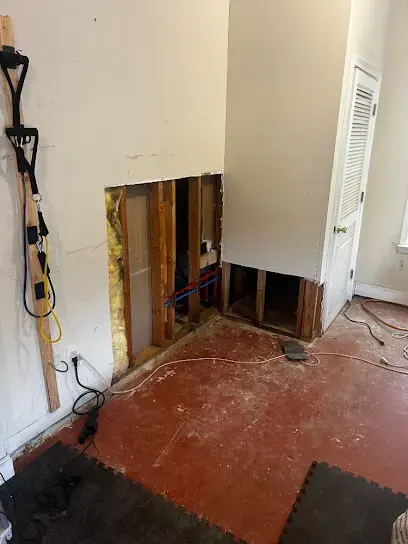
Supply water is clean when it leaves the pipe, which is good news: a burst pipe caught early is usually a Category 1 loss, and most of the structure can be dried in place if the drying team gets to it before the water degrades.
First steps for burst pipe water damage in Lilburn
- 1
Close the main valve
Find the main shutoff, usually near the meter or where the pipe enters the house, and close it.
- 2
Open a low faucet
Drain pressure from the system so less water reaches the break.
- 3
Keep clear of sagging ceilings
A ceiling holding water can fall; stay out from under bulges.
- 4
Photograph the break and rooms
Document the pipe, the water and every wet room before cleanup.
What does burst pipe water damage cost in Lilburn, GA?
In Lilburn, GA, burst pipe water damage cleanup typically runs $1,000 to $20,000, depending on how long the pipe ran, how many rooms and levels got wet, the material class and how fast drying started.
One room, caught fast
- Extraction
- Cavity drying in place
- Daily readings
Two levels or several rooms
- Ceiling and wall checks
- Targeted flood cuts
- LGR dehumidifiers
Ran for hours or days
- Category 2 handling
- Drywall and flooring removal
- Extended drying
Ranges are typical, not a quote: category of water, square footage, material class and how fast drying started move the number most. Run the Lilburn water damage cost calculator for a closer range.
How burst pipe water damage is handled in Lilburn
The tech who does the walkthrough maps moisture before any equipment goes down, so the drying plan matches what is actually wet. Equipment stays until the readings say dry, not until it looks dry.
- 1
Trace the water
Thermal imaging and meters follow water through walls, cabinets and into the level below.
- 2
Extract
Standing water and wet carpet extracted before it spreads further.
- 3
Open only what is wet
Drill holes or short flood cuts let drying air into wet cavities.
- 4
Dry and document
Readings logged daily until framing and drywall match the dry reference.
Why pipes fail in Lilburn homes
Homes built in Lilburn between about 1978 and 1995 may still carry polybutylene supply pipe, a gray plastic that becomes brittle with age and fails at the fittings. Older homes near Old Town Lilburn can have galvanized steel that corrodes from the inside. Newer homes use copper or PEX, which fail mostly from freezing, nail punctures and loose fittings.
- Polybutylene fittings that crack without warning.
- Galvanized pipe that rusts through at threads and elbows.
- Pipes in exterior walls, attics and crawl spaces that split in a hard freeze; see frozen pipe cleanup.
How the drying team handles a burst pipe
After the plumber stops the leak, the tech who does the walkthrough maps moisture with thermal imaging and pinless meters, following the water through wall cavities, under cabinets and down into the ceiling below. The extraction crew pulls standing water, then the team opens only the cavities that are actually wet, often with small drill holes or a short flood cut, and injects drying air into them.
- Category 1 water caught quickly lets most drywall dry in place.
- Water that sat for days can degrade to Category 2, which changes what gets removed.
- Ceilings below a burst pipe are checked for sagging before anyone stands under them.
The claim file for a sudden pipe burst
Sudden and accidental discharge from a burst supply pipe is the kind of loss many homeowner policies are written around, while slow leaks over months often are not. The claim depends on proof: timestamped photos before any demolition, the moisture map, the daily drying logs and the plumber's note on what failed. Coverage depends on your policy, so it is worth confirming with your own insurer. The Ready.gov water safety page covers electrical safety around standing water, and ceiling leak water damage covers the floor below.
Burst pipe water damage across Lilburn and southern Gwinnett
The Lilburn restoration crew covers ZIP 30047 and 30048, from Old Town Lilburn and the Camp Creek Greenway out along Killian Hill Road, Rockbridge Road and Five Forks Trickum Road.
Nearby coverage reaches Mountain Park, Stone Mountain, Snellville, Tucker, Lawrenceville, Norcross, Grayson.
Related water damage services in Lilburn
Burst Pipe Water Damage questions in Lilburn, GA
What should I do first when a pipe bursts?
Close the main water valve, open a low faucet to drain pressure, turn off power to wet rooms if the panel is dry, and photograph the damage.
Does all the wet drywall have to come out?
No. Clean water caught quickly can often be dried in place by injecting air into the wall cavity. Meters decide what is too wet to save.
How do I know if water is inside my walls?
Thermal imaging and pinless meters find water behind drywall that looks dry. Stains, bubbling paint and soft baseboards are later signs.
Does my house have polybutylene pipe?
Homes plumbed between roughly 1978 and 1995 may. It is usually gray plastic, often stamped PB, and is common near the water heater and under sinks.
How long does drying take after a burst pipe?
A contained Category 1 loss usually dries in 3 to 5 days. Hardwood, plaster and multi-level losses take longer.
Is a burst pipe covered by insurance?
Sudden and accidental pipe bursts are often covered; long, slow leaks often are not. Check your own policy, and keep the drying logs for the claim.
Pipe burst in your Lilburn home? Get it dried.
Clean supply water caught early can usually be dried in place. Waiting turns it into a tear-out.
(888) 532-4616Lilburn pipe burst drying, 24/7