Structural Drying and Dehumidification in Lilburn, GA
Dry to the touch is not dry. The drying team sets air movers and dehumidifiers to each room's load, takes readings every day and leaves the equipment until framing and subfloor match a dry reference.
(888) 532-4616Get the structure dried right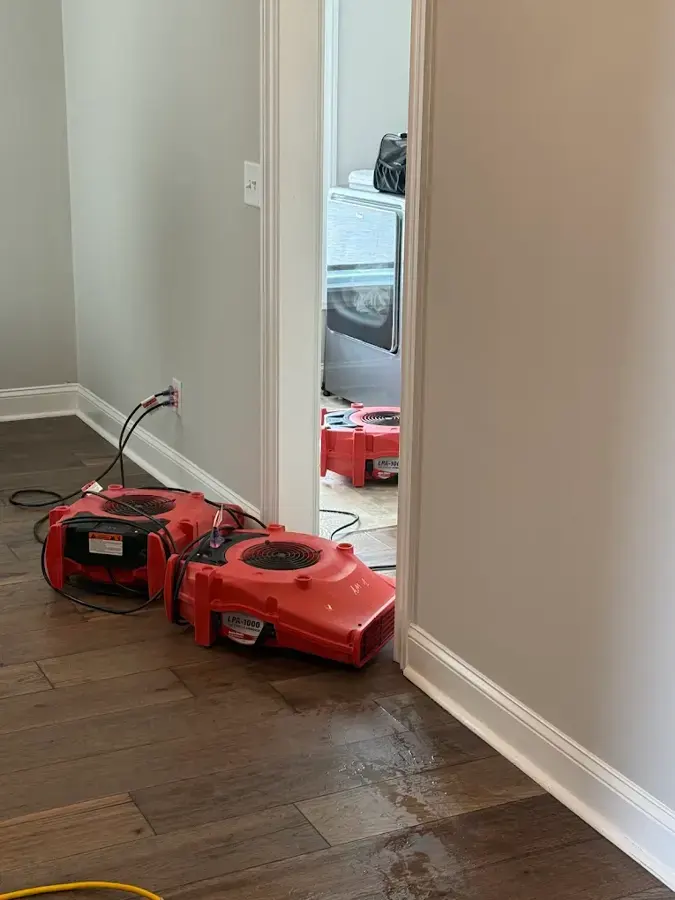
Structural drying is the part of a water loss that decides whether the house stays healthy. Framing, subfloor, drywall and slab hold water long after the floor looks dry, and Georgia's humid air slows evaporation even further without the right equipment.
First steps for structural drying and dehumidification in Lilburn
- 1
Keep the HVAC sensible
Run the air conditioning to help dry the air, unless the water was contaminated.
- 2
Open closets and cabinets
Let air reach wet areas behind doors and drawers.
- 3
Do not close up walls
Hold off on paint, trim and new flooring until readings confirm dry.
- 4
Keep the equipment running
Leave air movers and dehumidifiers on until the drying team pulls them.
What does structural drying and dehumidification cost in Lilburn, GA?
In Lilburn, GA, structural drying typically runs $800 to $15,000, depending on the class of water loss, the square footage, how much hardwood, plaster or block is involved and how fast drying started.
Class 1 or 2, one area
- Air movers
- LGR dehumidifier
- Daily readings
Several rooms or a level
- Wall cavity drying
- Hardwood mats
- Psychrometric logs
Class 4 or whole house
- Desiccant dehumidifiers
- Containment
- Extended monitoring
Ranges are typical, not a quote: category of water, square footage, material class and how fast drying started move the number most. Run the Lilburn water damage cost calculator for a closer range.
How structural drying and dehumidification is handled in Lilburn
The tech who does the walkthrough maps moisture before any equipment goes down, so the drying plan matches what is actually wet. Equipment stays until the readings say dry, not until it looks dry.
- 1
Moisture map
Meters and thermal imaging map every wet material and pick a dry reference.
- 2
Set equipment to load
Air movers and LGR or desiccant units sized to each room's class.
- 3
Log readings daily
Material and psychrometric readings recorded every day.
- 4
Pull on readings
Equipment comes out only when materials are within 2 to 4 points of the reference.
How drying is measured
IICRC S500 is the industry drying standard. Under it, the drying team takes a reading from a dry reference material in an unaffected part of the house, then dries wet materials until they land within 2 to 4 points of that reference. Psychrometric readings, temperature and relative humidity, show whether the air is actually pulling water out of the materials each day.
- Class 1 through 4 sets how much equipment a room needs.
- Air movers are set to the room's evaporation load, not a fixed number.
- Readings are logged daily for the claim file.
The equipment and why it is chosen
LGR (low grain refrigerant) dehumidifiers pull water from humid air efficiently, which matters in a Lilburn summer. Desiccant dehumidifiers take over for Class 4 materials like hardwood, plaster, block and slab that hold water tightly. Wall cavity systems push dry air into closed walls, and hardwood drying mats pull water up through boards. Thermal imaging and pinless meters track progress room by room.
- Equipment stays until the readings say dry, not until it looks dry.
- Containment can shrink the drying area so equipment works harder on wet rooms.
- Crawl spaces and basements get their own dehumidification; see crawl space water damage.
Why stopping early costs more
Pulling equipment when surfaces feel dry leaves water in the framing and subfloor, which shows up later as cupped floors, peeling paint, odor and mold. The EPA mold page explains why moisture control is the key, and the University of Georgia Extension covers humidity control in Georgia homes. Drying usually follows water extraction, and the final readings go into the claim file.
Structural drying and dehumidification across Lilburn and southern Gwinnett
The Lilburn restoration crew covers ZIP 30047 and 30048, from Old Town Lilburn and the Camp Creek Greenway out along Killian Hill Road, Rockbridge Road and Five Forks Trickum Road.
Nearby coverage reaches Mountain Park, Stone Mountain, Snellville, Tucker, Lawrenceville, Norcross, Grayson.
Related water damage services in Lilburn
Structural Drying and Dehumidification questions in Lilburn, GA
What does dried to IICRC S500 mean?
It means the drying followed the industry standard: moisture mapping, equipment sized to the class of loss, daily readings and drying until materials match a dry reference.
Why does the equipment stay so long?
Framing, subfloor and slab hold water after surfaces feel dry. The equipment stays until meter readings show the hidden water is gone.
What is an LGR dehumidifier?
A low grain refrigerant dehumidifier removes more water from humid air than a household unit, which matters in Georgia summers.
When are desiccant dehumidifiers used?
For Class 4 materials such as hardwood, plaster, block and concrete, and in cool conditions where refrigerant units slow down.
How long does structural drying take?
A contained Class 1 or 2 loss usually dries in 3 to 5 days. Hardwood, plaster and multi-level losses take longer.
Can I turn the equipment off at night?
No. Drying depends on steady airflow and dehumidification. Turning it off stalls the drying and can extend the job.
Need the structure dried to standard? Call now.
Dry to the touch is not dry. The drying team leaves equipment until the readings prove it.
(888) 532-4616Lilburn structural drying, 24/7