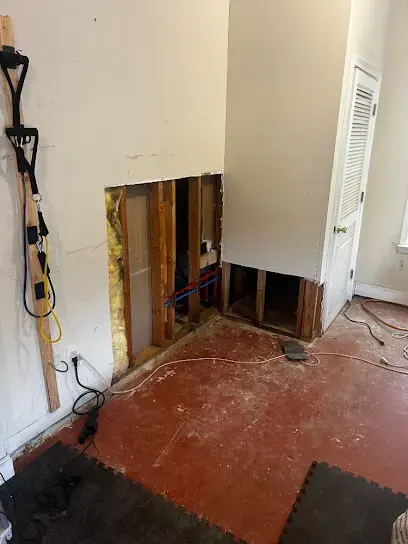
Most Lilburn homes went up between the 1970s and the 1990s. Homes plumbed between roughly 1978 and 1995 can still carry polybutylene supply pipe, and a failure in that pipe is often sudden.
Key takeaways
- Polybutylene is a plastic supply pipe used in homes plumbed in roughly the late 1970s through the mid 1990s, and some Lilburn homes still have it.
- Older homes in Lilburn may instead have galvanized steel supply pipe.
- A supply pipe failure under pressure can release a lot of water quickly, unlike a slow drain leak.
- Shut off the main water valve first, then power to the wet area if it is safe.
- Walls are opened only where moisture readings say water is trapped.
The Lilburn housing background
Most of Lilburn was built between the 1970s and the 1990s, around the older rail town core of Old Town Lilburn. That is the same window in which polybutylene was used for home supply pipe.
Homes plumbed between roughly 1978 and 1995 can still carry it. Older homes may have galvanized steel instead.
How to spot it
Polybutylene pipe is plastic and usually gray, and it is often found near the water heater, the main shutoff and under sinks. A plumber can confirm what a house has.
Not every home from that era has it, and some have been repiped. Knowing which applies saves guesswork.
Galvanized steel in older homes
Galvanized steel pipe corrodes from the inside. Flow slows and rust can show at the tap, and joints can leak.
It fails differently from plastic, usually as a slow weep that stains, and then a larger failure.
Why a supply pipe burst is different
A supply pipe carries water under pressure all day. When it splits, the water does not just drip, it sprays or runs steadily.
A drain leak only leaks when a fixture is used. A supply failure leaks around the clock until the main is shut off.
Because the pressure never stops, a small failure can wet several rooms before anyone is home to notice. A split near a water heater, a bath or a laundry room can reach flooring on two levels.
Insurance adjusters look at how long water ran. Photographing the meter and the main shutoff helps show that the water was stopped quickly.
- A hissing or running sound inside a wall when no tap is open.
- A water meter that keeps moving with every fixture off.
- Warped baseboards, bubbling paint or a damp smell near a wall.
- A stained ceiling below a bath, laundry room or kitchen.
- A sudden drop in water pressure.
What to do in the first minutes
The goal is to stop the source and keep the water from spreading. Order matters.
- Shut off the main water valve at the meter or where the supply enters the house.
- Turn off power to the wet area at the panel only if the panel is dry and reachable.
- Open a low faucet to drain the pipes and relieve pressure.
- Move furniture, rugs and electronics out of the wet area.
- Photograph the damage before anything is changed.
How the water travels in a house
Water follows gravity and material. In a split level, it can run down from an upper bath to a lower room.
In a house with a basement, water that begins at a kitchen or bath on the main floor can end up on the basement ceiling and floor.
In an older Lilburn house, the supply pipes often run through the same wall cavities as electrical wiring. Wet framing around wires is another reason to keep power off the wet area until it is checked.
When water has spread across a floor, the drying team works from the source outward. That way the wettest material is handled first and the dry edge is protected.
Inside the wall
Water runs down inside the wall cavity and wicks into drywall, insulation and the bottom plate. Paint can hide it for a long time.
That hidden water is why moisture meters are used before anything is closed up.
Under the floor
Water that reaches a floor can move under hardwood, laminate and vinyl and into the subfloor. A crawl space below can collect it.
Many Lilburn homes sit on vented crawl spaces, so water that drips through the floor may end up there.
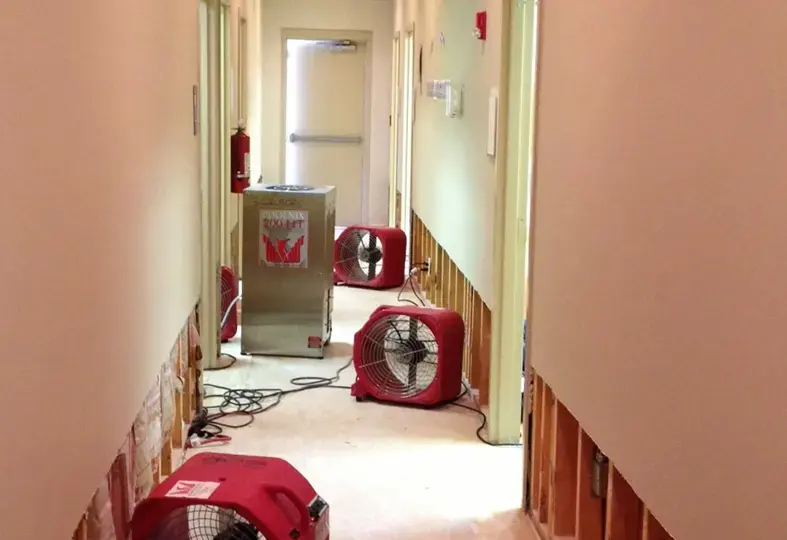
How the crew dries a supply pipe failure
The extraction crew removes standing water. The drying team then maps where it went with meters and a thermal camera.
Wall cavities are opened only where readings say water is trapped. That keeps rebuilding small.
- Extract: pull standing water from the floor.
- Map: find wet drywall, insulation and subfloor with meters and a thermal camera.
- Open: cut access only where readings point.
- Dry: run air movers and dehumidifiers to a reading.
- Document: record readings for the insurance file.
Repiping and prevention
A plumber decides whether a section can be repaired or whether the house should be repiped. After a failure in an old supply pipe, many owners choose to replace more than the broken section.
The water damage cost calculator helps plan for the water damage side of a job, and the drying time estimator shows how long drying can take.
A plumber can also check pressure at the main. High pressure strains old pipe and fittings, and a regulator is a small part that guards the rest of the system.
- Learn where the main shutoff is and test that it turns.
- Ask a plumber what type of supply pipe the house has.
- Watch the water meter during a period when no one is home.
- Consider a leak detector near the water heater and under sinks.
Getting help in Lilburn
The page for burst pipe water damage in Lilburn describes the process from shutoff to dry. For walls and floors that stay wet, see structural drying.
The full list of places served is on the service area page.
Questions
Do all Lilburn homes have polybutylene pipe?
No. Homes plumbed between roughly 1978 and 1995 can still carry it, but many have been repiped, and older homes may have galvanized steel instead.
How can an owner tell what supply pipe a house has?
A plumber can identify it. Polybutylene is plastic, often gray, and is usually visible near the water heater or main shutoff.
What is the first thing to do when a supply pipe bursts?
Shut off the main water valve. That stops new water, and then power, photos and moving belongings come next.
Can the water be hidden inside a wall?
Yes. Water runs down inside cavities and wicks into drywall and insulation. Moisture meters and a thermal camera find it before anything is closed.
Does the whole house need to be repiped after one failure?
That is a plumber's call. Many owners replace more than the broken section when the pipe is old.
Why do supply pipes fail more suddenly than drains?
They hold water under pressure at all times, so a split sprays or runs without pause. A drain only carries water when a fixture is used.