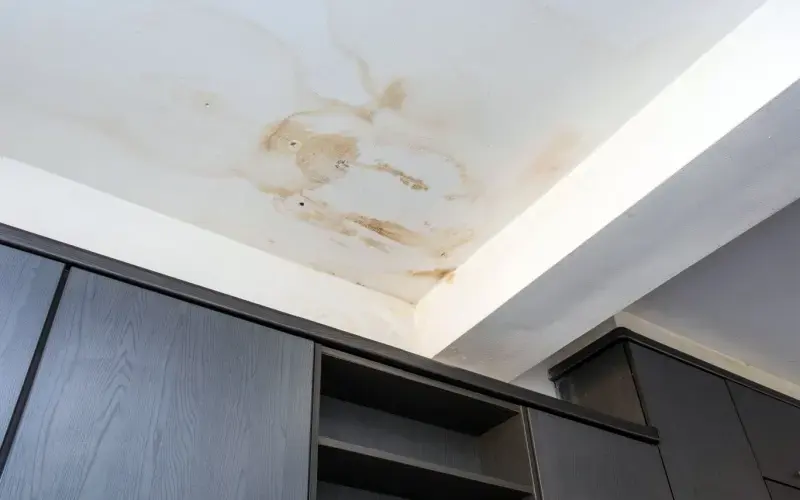
In a two story house, the kitchen or den downstairs sits under a bathroom upstairs. When that bathroom leaks, the first sign is often a brown stain or a sagging patch on the ceiling below.
Key takeaways
- Amberfield, off Peachtree Parkway, is a neighborhood of executive two story homes mostly built in the 1990s.
- Peachtree Corners has a median home build year of 1989, and about 38.2% of homes were built from 1980 to 1989.
- A ceiling stain means water is already trapped in the joist bay and insulation above it.
- A sagging ceiling can drop without warning, so keep people out of the room below.
- Finding the source first keeps the same leak from wetting the ceiling again.
Two story homes and their leak patterns
Peachtree Corners has 18,858 housing units, and about 38.2% of them were built from 1980 to 1989. Another 27.1% date from the 1990s.
Amberfield, off Peachtree Parkway, is a neighborhood of executive two story homes mostly built in the 1990s. Upstairs baths and laundry rooms sit directly over living space in houses like those.
Why upstairs leaks reach the ceiling
A bath leak starts in a place most people never look: under the tub, behind a toilet or inside the wall by a shower valve.
The water drips into the floor structure, runs along the joists, and soaks into the drywall ceiling below.
Other upstairs sources
A laundry room, a second floor kitchen or a bathroom sink can leak the same way. So can a supply pipe running through the floor.
Signs the ceiling is holding water
A ceiling does not always announce a leak. Some signs are small.
A leak that stays small can still do harm. Water that sits in a joist bay keeps wicking into framing, insulation and drywall for days.
The longer a stain is left, the more drywall and insulation must be cut out. A ceiling that is opened early often needs a smaller patch.
- A brown or yellow stain that grows or gets darker over days.
- Paint that bubbles, peels or cracks in a patch.
- A sag or bulge, which means drywall is holding a pool of water.
- Drips from a light fixture or vent, which means water is near wiring.
- A musty smell in the room below the bath.
Safety first when a ceiling is wet
Wet drywall is heavy. A sagging section can collapse, and water above a light fixture is an electrical hazard.
Keep people and pets out of the room until the area is checked.
- Turn off power to the room at the panel if water is dripping from a light or fan.
- Shut off the water supply to the upstairs fixture or the main if the source is unknown.
- Move furniture and electronics out from under the stain.
- Place a bucket under any drip and poke a small hole at the lowest point of a bulge to drain it safely, standing to the side.
How the source is traced
Stopping the leak comes before drying. Without that, the ceiling just gets wet again.
The crew checks the likely source with moisture meters, a thermal camera and a look at the plumbing above.
If the bathroom is above a finished room, the crew works from below as well. A small camera can look into a joist bay through a hole the size of a coin.
Peachtree Corners homes include executive two story houses, townhomes in Town Center and a large share of multi unit buildings. Each layout puts pipes in a different place, so the source search starts with the plan of the house.
Gwinnett County Department of Water Resources manages the public water and sewer system. Plumbing inside the home is the owner's responsibility, and the crew focuses on the water that has escaped it.
Supply leak or drain leak
A supply leak runs all the time, even when no one is using a fixture. A drain leak only runs when water goes down the drain.
Watching the water meter with everything off helps tell them apart.
Tub, shower and toilet clues
Cracked grout, failed caulk, a worn shower valve or a leaking toilet seal are common culprits.
Running the shower or flushing while someone watches the ceiling below can show which fixture is the source.
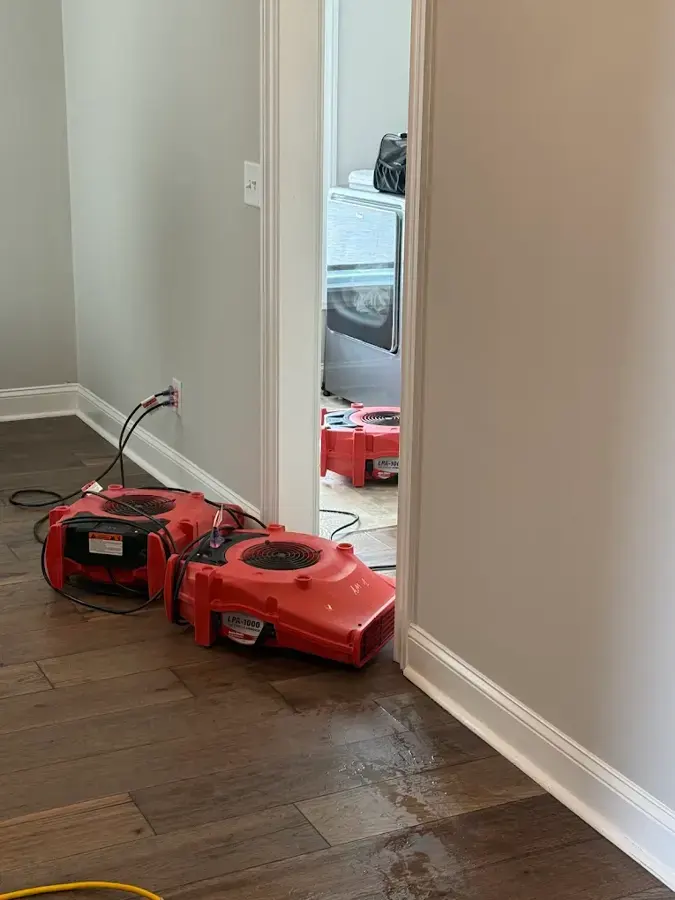
How the ceiling and joist bay are dried
Once the leak is stopped, the drying team opens the ceiling where it is wet. Water in the joist bay and insulation has to come out.
The extraction crew pulls any pooled water, and then the drying equipment goes in.
- Open: cut away wet drywall in a clean shape, so patching is simple.
- Remove: take out wet insulation, which holds water for a long time.
- Dry: run air movers and dehumidifiers, and check readings in the framing.
- Document: log the readings for the insurance file.
- Patch: once dry, drywall and paint restore the ceiling.
Shared walls and rental units
About 35.8% of Peachtree Corners homes are in buildings of five or more units, and about 47.0% of occupied homes are rented. A leak above a ceiling may start in a neighbor's unit.
Tell the property manager right away, so the source unit and the affected unit can both be checked.
In a multi unit building, a ceiling leak can come from a unit above, a shared riser or a roof. Each owner or tenant should keep a copy of reports and photos.
- Photograph the damage before anything is changed.
- Report the date the stain appeared.
- Ask the manager which unit is above.
Help in Peachtree Corners
The page for ceiling leak water damage in Peachtree Corners describes the process. For joists and subfloor that stay wet, see structural drying in Peachtree Corners.
The Peachtree Corners hub lists the other services, and the ceiling leak overview gives a wider picture. The drying time estimator shows how long drying can take.
Questions
Why does a ceiling stain appear below an upstairs bathroom?
Water from the bath drips into the floor structure, runs along the joists and soaks through the drywall ceiling below.
Is a sagging ceiling dangerous?
Yes. Wet drywall is heavy and can collapse, and water near a light can be an electrical hazard. Keep people out of the room.
Should the leak be fixed before the ceiling is dried?
Yes. If the source is not stopped, the ceiling will get wet again.
Does wet insulation have to be replaced?
Usually. Insulation holds water for a long time and loses its effect when wet, so it is removed and replaced.
What if the leak starts in a neighbor's unit?
Tell the property manager right away so both units can be checked and the source can be stopped.
How long does a wet ceiling take to dry?
It depends on the area and how long it stayed wet. The drying team measures moisture in the joists and drywall and keeps equipment running until readings match a dry reference.