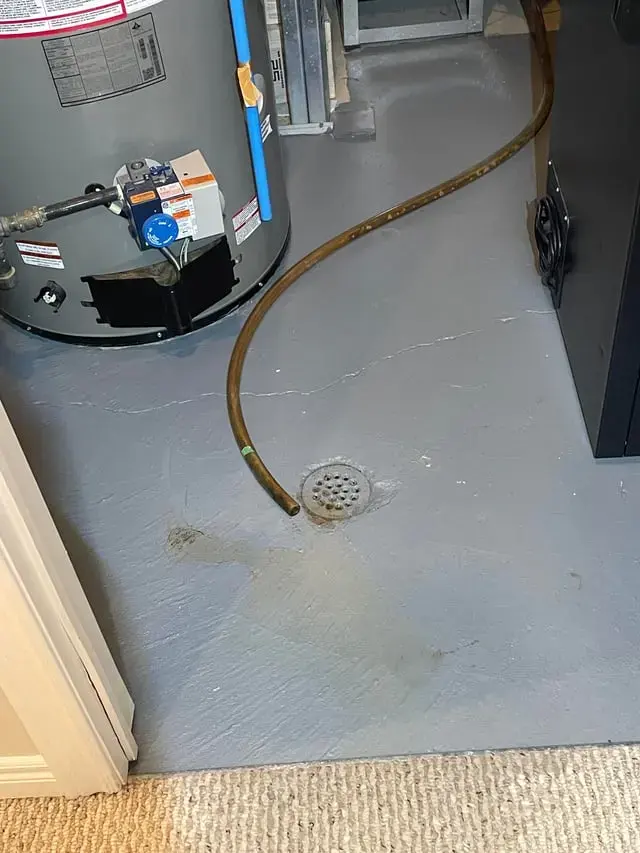
Tucker has a lot of older housing, and an older house usually means an older tank. When a water heater lets go, the water goes for the nearest low spot: a closet floor, a garage slab or the baseboard of the next room.
Key takeaways
- More than 70% of Tucker's housing was built before 1990, and over half before 1980.
- ACS based estimates put Tucker's median year built near 1981.
- Ranch and split level houses are among the house types documented in the city's 2019 historic housing report.
- A leaking tank is shut off at the cold supply valve and the power or gas control, then drained and replaced.
- The room around the tank is dried to a moisture reading, including the wall behind it.
Why Tucker's housing age matters
More than 70% of Tucker's housing was built before 1990. Over half was built before 1980, and median year built sits near 1981 in ACS based estimates.
Tucker added about 390 homes per year on average in the 1970s, compared with about 177 per year in the 2010s. That building boom left a lot of houses that are now decades old.
Ranch and split level layouts
Ranch and split level houses are among the house types in the city's 2019 historic housing report.
In a ranch, a leaking tank in a utility room or closet spreads across one level. In a split level, water can run down a half flight of stairs to a lower floor.
Most homes are owner occupied
About 62% of Tucker households own their home and 38% rent, based on a 2023 estimate. A renter should tell the landlord right away, because the tank belongs to the building.
How a water heater tank fails
A tank is a steel container with a protective lining. Over time the lining breaks down and the steel rusts, and eventually it develops a pinhole or a seam crack.
That failure is not always a flood. Sometimes it is a slow weep that stains a floor, and sometimes it is a burst.
Tucker is in the Georgia Piedmont, and DeKalb County provides the drinking water through Watershed Management. Water chemistry and sediment vary, so a tank's age is only part of the story.
A tank that is often serviced can outlast one that is ignored. Checking it every few months catches slow leaks before they stain a floor.
- Rust colored water at the hot tap.
- Puddles or dampness around the base of the tank.
- Dripping from the relief valve discharge pipe.
- Rumbling or popping sounds from sediment inside the tank.
- Corrosion on the fittings at the top of the tank.
Where the water goes
Location decides how much damage a leak does. The same tank can soak a floor or a whole wall depending on where it sits.
Tucker has established neighborhoods such as Smoke Rise, Edinburgh Estates, Winding Woods and Wellington. Whatever the layout, the first questions are the same: where is the tank and which materials are touching the water.
In a closet or utility room
Water runs under the door and into baseboards, drywall and nearby flooring. Hallways beside a closet pick up the spread.
Drywall wicks water upward, so a wall can be wet well above the visible water mark.
In a garage
A garage slab spreads water thinly over a wide area. It can run under walls into the house.
Stored cardboard, tools and cabinets pick up water fast.
In an attic
A tank in an attic sends water into insulation and through the ceiling below. By the time a stain shows, a lot of insulation is wet.
What to do the moment a tank leaks
Speed matters here. A few quick steps limit how far the water travels.
- Turn off the power or gas supply to the tank.
- Close the cold water supply valve on top of the tank.
- Open a hot tap to relieve pressure, and connect a hose to the drain valve if it is safe.
- Move boxes, rugs and furniture out of the water.
- Photograph the tank, the floor and any wet walls.
How the cleanup works
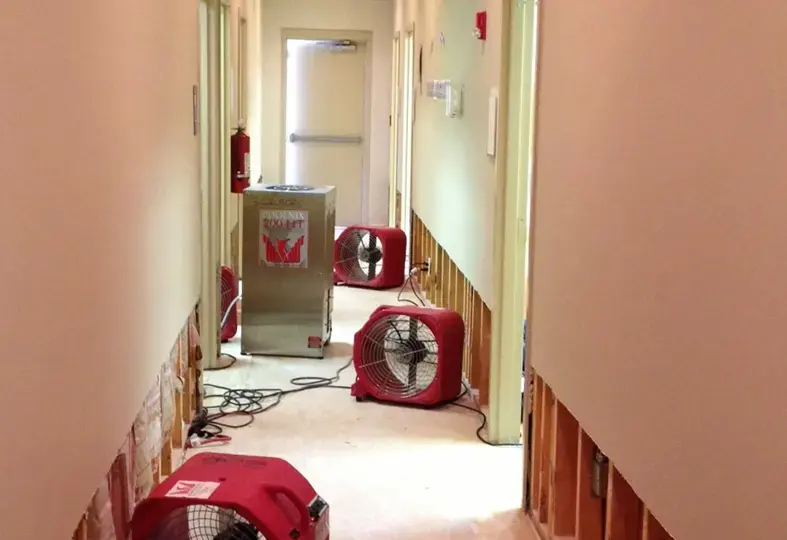
The extraction crew removes standing water first. Then the drying team checks the room with moisture meters and a thermal camera to find where water went.
Most of the work is drying, not demolition. Flooring, baseboard and the bottom of drywall come out only if readings show they cannot dry in place.
Drying the wall behind the tank
A wall behind a tank is often wet inside the cavity even when the surface looks dry. The crew uses meters to confirm it before covering anything.
A small hole may be drilled so air can reach the cavity.
Drying to a reading
Air movers and dehumidifiers stay in place until readings match a dry reference. The drying time estimator gives an idea of what affects the timeline.
Replacing the tank and protecting the floor
A leaking tank is replaced, not repaired. A plumber handles the swap, and the restoration crew handles the water.
A drain pan under the new tank catches small drips. It does not hold a full tank failure, so regular checks still matter.
After a tank leak, the crew may also check the floor drain, the pan and nearby walls for moisture left behind. A final reading confirms the area is dry before the plumber reconnects the new tank.
- Look at the base of the tank every few months.
- Drain a few gallons periodically to clear sediment, following the manufacturer.
- Replace a tank that shows rust at the seams or corroded fittings.
- Keep stored items off the floor around the tank.
Help in Tucker
The page for water heater leak cleanup in Tucker explains how the work runs. For floors, walls and framing that stay wet, see structural drying in Tucker.
The Tucker service hub lists the other services, and the page on water heater leak cleanup gives a wider overview.
Questions
How old is the typical Tucker home?
More than 70% of Tucker's housing was built before 1990 and over half before 1980. ACS based estimates put the median year built near 1981.
Can a leaking water heater be repaired?
Usually not. A leak in the tank itself means the tank has failed, so it is replaced. A leak at a fitting or valve can sometimes be fixed by a plumber.
Does a drain pan stop all damage?
No. It catches small drips, but a full tank failure can overflow it.
What gets dried after a tank leak?
The floor, baseboard, the lower wall and anything stored nearby. The wall cavity behind the tank is checked with a meter as well.
Who handles a tank leak in a rental?
The tenant should tell the landlord right away. The tank belongs to the building, and the landlord arranges the replacement.
Does a rental tenant pay for tank damage?
The tank belongs to the building, so the landlord handles the replacement. Tenants should still document damage to their own belongings and tell the landlord and their renter's insurer.