Crawl Space Water Damage in Stone Mountain, GA
Red clay holds rain against foundations, so houses from the 1960s to the 1980s can end up with water pooled under the floor. The crew clears it with pumps, strips the wet barrier and dries the joists.
(888) 532-4616Water under the floor? Start pumping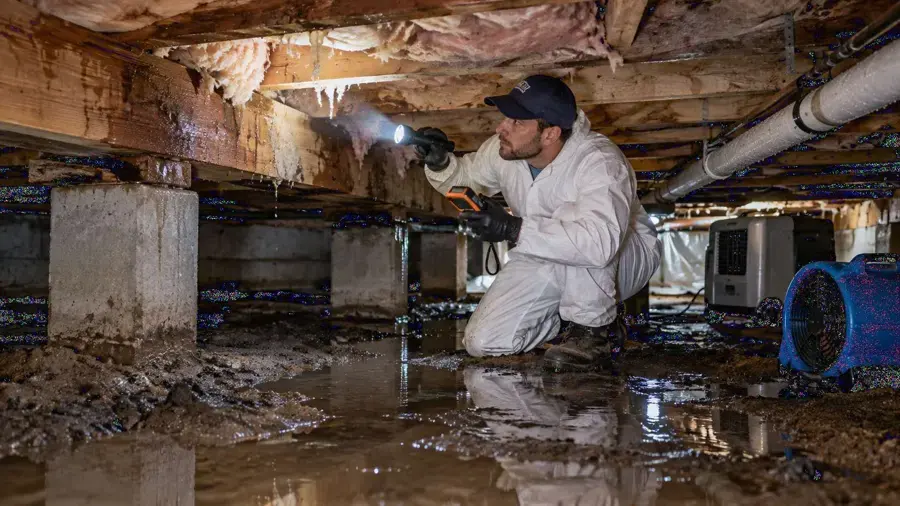
The median house in Stone Mountain dates from 1979, and many from the 1960s through the 1980s sit on raised floors. When rain or a leaking pipe puts water under one, the vapor barrier, insulation and joists can stay wet long after the sky clears.
First steps for crawl space water damage in Stone Mountain
- 1
Peek, don't enter
Water near wiring and ducts can shock or contaminate, so look in only from the access door.
- 2
Cut off any supply
A leaking pipe means closing the main valve. Water coming up through the street is the utility's concern.
- 3
Photograph it all
Record the water depth, the barrier and drooping insulation from the hatch for the claim.
- 4
Check the rooms above
Press on soft floor spots and notice cupped boards or an odor in the rooms over the wet area.
What does crawl space water damage cost in Stone Mountain, GA?
Cleaning up a wet crawl space in Stone Mountain, GA usually costs $1,000 to $15,000. A little clean water caught early costs the least, while soaked insulation, contaminated water and a pool that sat for days push the figure up.
Small and clean
- Water pumped out
- Wet barrier hauled off
- Fans and a dehumidifier
Entire crawl space soaked
- Wet insulation out
- Antimicrobial on framing
- Daily joist readings
Contaminated or long-standing
- Category 3 protocol
- Air scrubbers running
- Extended drying
Ranges are typical, not a quote: category of water, square footage, material class and how fast drying started move the number most. Run the water damage cost calculator for a closer range.
How crawl space water damage is handled in Stone Mountain
The tech who does the walkthrough maps moisture before any equipment goes down, so the drying plan matches what is actually wet. Equipment stays until the readings say dry, not until it looks dry.
- 1
Assess from the hatch
Depth, source and nearby wiring are checked at the hatch before anyone climbs in.
- 2
Pump and strip
Pumping comes first, then the soaked barrier and insulation are bagged and hauled off.
- 3
Treat, then dry
Antimicrobial goes on exposed framing before air movers and a dehumidifier start on the joists and decking.
- 4
Verify, then reseal
The new barrier is laid only when wood readings match a dry sample.
Why a crawl space collects water here
Georgia Piedmont red clay drains slowly, so storm runoff tends to sit against the foundation and seep toward the lowest point under the floor. Gutters that dump at the wall, soil that slopes toward the house and a leaking drain or supply pipe all add to it.
- Heavy rain pooling against the foundation and moving under the house.
- Supply or drain leaks that run unseen for days beneath the floor.
- Cold-snap pipe breaks like those county officials warned about during Winter Storm Fern; see frozen pipe cleanup in Stone Mountain.
How the crawl space crew dries it out
Because the water has travelled over soil, the crew wears suits and respirators and works it as Category 2 or 3. Pumps take the standing water first. The soaked barrier and wet insulation are then bagged and carried away, since neither will dry where it hangs. Air movers and a dehumidifier follow, aimed at the joists, sills and decking.
- Wood readings taken daily against a dry sample.
- An EPA-registered antimicrobial applied to touched framing.
- A fresh barrier goes in once the soil and framing test dry.
How it reaches the floors upstairs
Moisture drifts up through the subfloor. In the rooms above it shows as cupped hardwood, a stale odor or air that never feels dry. Fast drying below can spare the floor above from replacement. The Stone Mountain water damage hub lists the other losses common around the city, and structural drying in Stone Mountain explains how the dry-out is measured.
Crawl space water damage across Stone Mountain and nearby towns
The Stone Mountain crew works across ZIP 30083, 30086, 30087 and 30088, from the village historic district and Shermantown to Smoke Rise, Hidden Hills and the Rockbridge Road corridor.
The same service nearby: crawl space water damage in Lilburn, Tucker, Clarkston.
Water damage restoration in Stone Mountain · every town covered
Related water damage services in Stone Mountain
Crawl Space Water Damage questions in Stone Mountain, GA
How do I know water is under my Stone Mountain house?
Look for a stale smell indoors, springy or cupped floors, sticky air and ducts that sweat. After hard rain, a flashlight check at the hatch usually settles it.
Is water under the house a health risk?
It has travelled over soil, so it is treated as Category 2 or 3 and handled in protective gear. Extra humidity can also let mold take hold on wood in the rooms above within days.
Does the barrier always come out?
When water has pooled on it, yes, so the soil and framing under it can dry. Once readings come back normal, a new barrier goes down.
How soon will the crawl space be dry?
Many dry within a week after the water and wet insulation go. Soaked sills and decking can take longer, and readings decide when the equipment leaves.
Can storm runoff near the creeks reach a crawl space?
Runoff finds the lowest point, and a crawl space is often it. Little Stone Mountain Creek and Stone Mountain Creek are NWS flood-gauged, so a look under the house after a big storm is smart.
What helps keep water out from under a house?
Downspouts that empty well clear of the foundation and yard soil sloped off the walls do the most. The seepage risk check points out the usual weak spots.
Water under your Stone Mountain house? Start the pump-out.
Clay soil and humid summers keep wood damp for weeks. The drying team places equipment the moment the standing water is gone.
(888) 532-4616Stone Mountain crawl space drying, 24/7