Structural Drying and Dehumidification in Clarkston, GA
A wall can feel dry while the studs inside it are still wet. The drying team chooses fans and dehumidifiers to suit each room, checks moisture daily and keeps the machines running until the framing agrees with a dry sample.
(888) 532-4616Get the building dried properly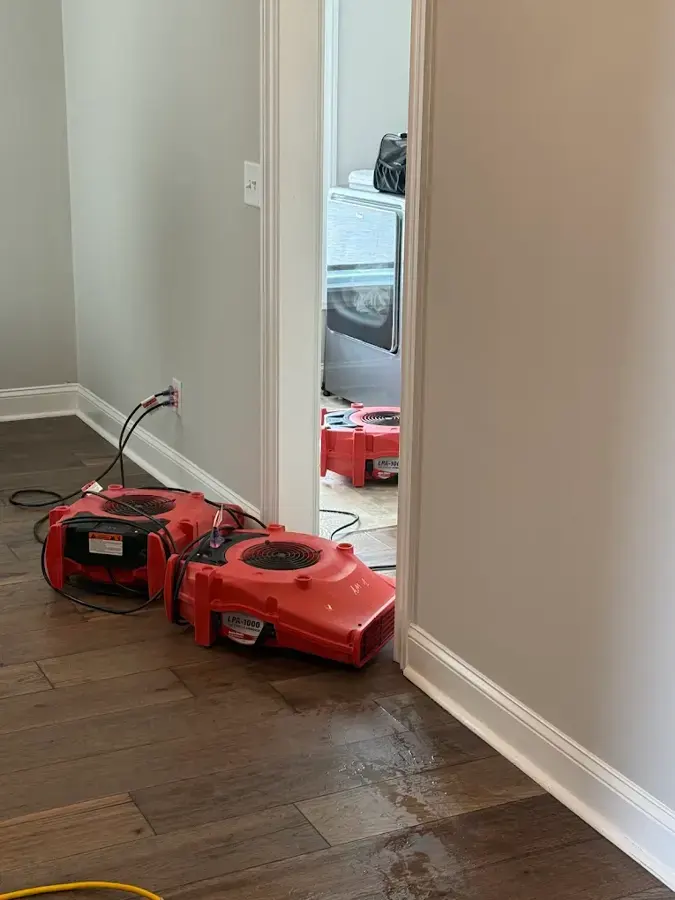
Of all the stages in a water loss, drying decides whether a building stays sound. Studs, subfloor, drywall and slabs keep water long after a floor looks fine, and Georgia's humid air slows evaporation further.
First steps for structural drying and dehumidification in Clarkston
- 1
Keep the air running
Cooling helps dry the air, so keep it on unless the water was contaminated.
- 2
Open closets and cabinets
Give air a path to wet areas behind doors and drawers.
- 3
Wait on repairs
Hold off on painting, trim and flooring until readings confirm dry.
- 4
Leave machines alone
Keep fans and dehumidifiers on until the drying team takes them away.
What does structural drying and dehumidification cost in Clarkston, GA?
A structural drying job in Clarkston, GA typically costs $800 to $15,000, depending on the class of loss, the area involved, how much hardwood, plaster or block got wet and how fast drying began.
A light loss in one area
- Fans set up
- One LGR dehumidifier
- Daily readings
A few rooms or a level
- Wall cavity drying
- Floor mats
- Humidity logs
Class 4 or a whole building
- Desiccant machines
- Containment
- Long monitoring
Ranges are typical, not a quote: category of water, square footage, material class and how fast drying started move the number most. Run the water damage cost calculator for a closer range.
How structural drying and dehumidification is handled in Clarkston
The tech who does the walkthrough maps moisture before any equipment goes down, so the drying plan matches what is actually wet. Equipment stays until the readings say dry, not until it looks dry.
- 1
Chart the wet spots
A thermal camera and meters find wet materials and a dry sample to aim for.
- 2
Fit machines to the load
Fans and LGR or desiccant units are chosen for each room's class of loss.
- 3
Measure daily
Material and air readings go in the log every day.
- 4
Release on the numbers
Machines leave only when materials come within 2 to 4 points of the sample.
Why the cut line is not the finish line
After the October 4, 2022 flood at Silver Oak Apartments on Brockett Road, DeKalb County said it was authorized to remove 4 vertical feet of wall in the affected areas. A cut at that height still leaves the wall above it, the framing and the floors to be proven dry, which is why readings above the cut line matter. Shared walls add another reason, since dry air has to reach every cavity, including the ones between units.
- Wetter, denser materials need more machines than a light loss.
- Fan placement follows how much water a room can give up.
- Each day's numbers go into the claim file.
Equipment, and why each piece is chosen
Low grain refrigerant (LGR) dehumidifiers remove water from muggy air efficiently, a real advantage in a Georgia summer. Desiccant units handle dense materials such as hardwood, plaster, block and slab, which hold water tightly. Wall cavity systems push dry air inside closed walls, mats draw moisture out of floorboards, and a thermal camera with pinless meters shows progress room by room.
- Machines run until readings say dry, however the surface looks.
- Containment narrows the space being dried so the equipment concentrates on wet rooms.
- Raised floors and lower levels need their own dehumidification; see crawl space water damage.
Why stopping early costs more
Unplugging machines because surfaces feel dry leaves moisture in framing and subfloor, and it comes back as cupped floors, flaking paint, odor and mold. Drying normally follows water extraction, and the closing readings go into the claim file. Tenants should keep machines running and tell the property manager if someone switches them off.
Structural drying and dehumidification across Clarkston and nearby towns
The drying team serves ZIP 30021, including the Brockett Road corridor, the Multifamily Redevelopment Area, Downtown Clarkston and the East Ponce de Leon Avenue corridor.
The same service nearby: structural drying and dehumidification in Lilburn, Tucker, Stone Mountain.
Related water damage services in Clarkston
Structural Drying and Dehumidification questions in Clarkston, GA
What does a dry reading under IICRC S500 mean?
The crew followed the published industry method: a moisture map, machines chosen for the class of loss, daily readings and a finish line taken from a dry sample.
Why do the machines run for days?
Water hides in studs, subfloor and slab even once surfaces feel dry. The machines stay until meter readings show that hidden moisture is gone.
What makes an LGR unit different?
Low grain refrigerant dehumidifiers pull far more water from damp air than a household dehumidifier, which matters through a muggy Georgia summer.
When does a desiccant machine join in?
On dense Class 4 surfaces such as hardwood, plaster, block and concrete, and in cool rooms where refrigerant units lose efficiency.
Is it fine to unplug the machines overnight?
No. Drying needs constant airflow and moisture removal, and an off-night stalls progress and can add days.
How many days does structural drying take?
A tidy Class 1 or 2 loss tends to finish within 3 to 5 days, whereas hardwood, plaster and multi-level losses take more time.
Damp framing after cleanup? Get it dried properly.
A surface that feels dry can still hide wet studs. The drying team stays until the numbers agree.
(888) 532-4616Clarkston structural drying, 24/7